Wednesday, 2 April 2014

DAY 8: SEAFOOD LUNCH AT THE PORT CHARLOTTE HOTEL, ISLAY HOUSE AND RSPB RESERVE AT LOCH GRUINART

Sunday 28th July

My friend Kate Jones, who like me originates from Shropshire, has a delightful whitewashed terraced cottage up the road in Port Charlotte, called ‘Cillebhride’, and she was my mentor and enthusiastic guide around the island for the next 5 days. Kate showed me around her delightful, renovated home and garden which is typical of the island, and then we planned our itinerary over an excellent seafood lunch at the adjacent Port Charlotte Hotel. Our first car drive was to the elegant Islay House, which dates back to the 18th century, and its extensive walled kitchen garden that originally supplied the household. It has now been redeveloped as a Community Garden, tended by volunteers and  where members of the public like me can pick out and buy their own delicious organic produce.  


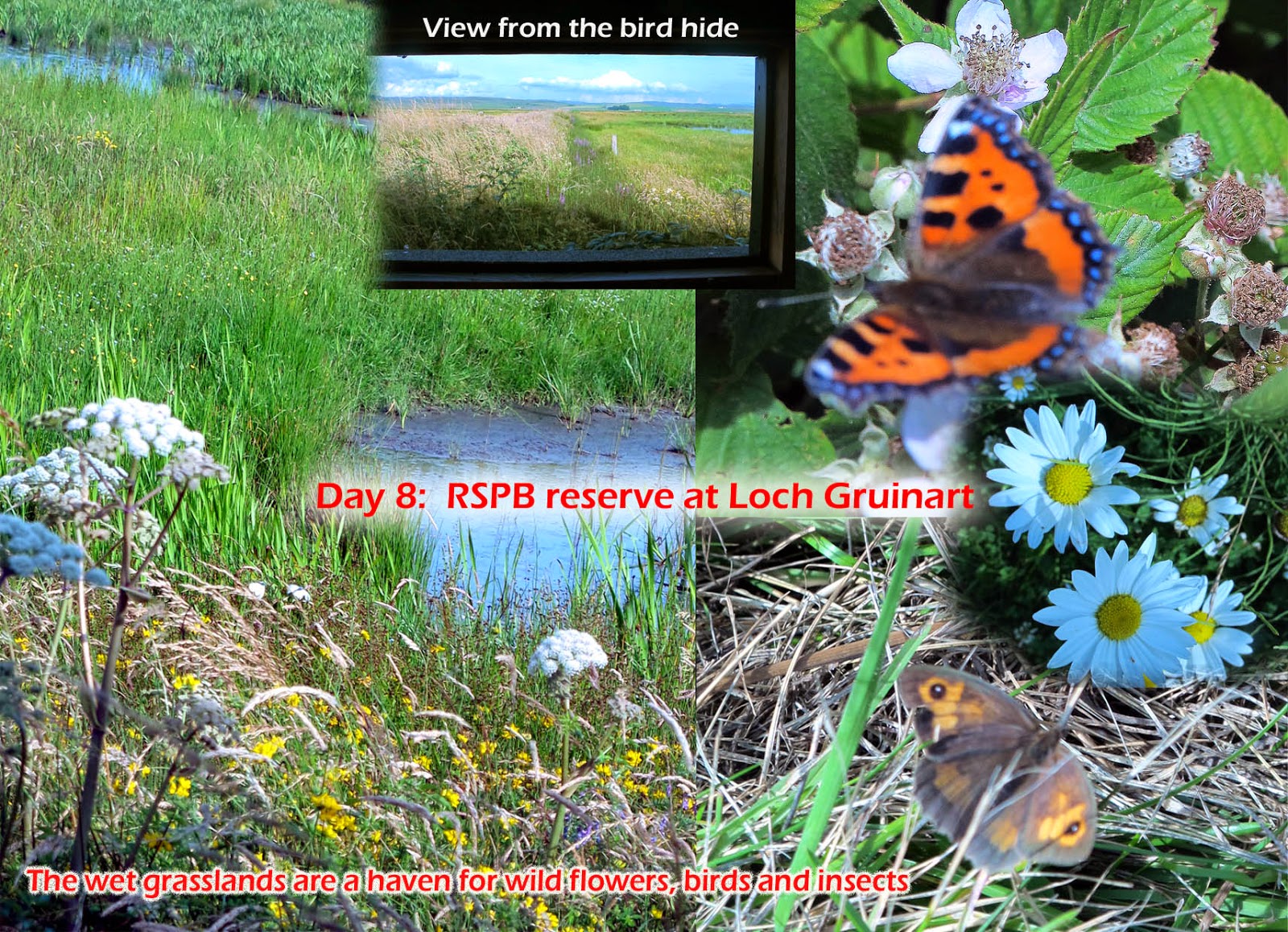
Then onto the RSPB reserve at Loch Gruinart, where we strolled along lanes and through meadows brimming with a profusion of wild flowers, and butterflies such as meadow browns, green-veined whites, tortoiseshells and small blues. Such sights remind me of my childhood and walks around the country of lanes of Tilley where I grew up. It is heart-warming to know that environments still exist in the UK that seem to have escaped the corrosive impact of pesticides and pollution. From the bird hide we looked out over wetlands where farm animals grazed in a landscape that has remained largely unchanged for centuries. Thousands of geese flock here every winter and shy corncrakes call from patches of nettles in the spring. We had hopes of eyeing a golden eagle - reputed to fly in this terrain, however, we were to be disappointed and concluded that they must all be taking an afternoon nap! 

Monday, 31 March 2014

DAY 7: FERRY CROSSING AND FIRST IMPRESSIONS OF ISLAY

Saturday 27th July

After breakfast and the tricky manoeuvring around the dips and ditches required to evacuate my picturesque hilltop campsite (not really compatible with a 22’ motorhome!), it was a short drive from Corran Farm to the ferry departure point of Kennacraig Port Ferry Terminal.  The impressive Caledonian MacBrayne ferry boat, the ‘Hebridean Islands’ sailed into view and docked and the embarkation procedure swung into action. The queuing vehicles entered up the ramp in single file and disappeared into the bowels of the ship in a sort of conjuring trick, as vans, cars, large articulated lorries, petrol tankers, camper vans, cyclists, motorbikes and foot passengers, were all effortlessly slotted into the available space, cheek by jowl. Bellulu was the last vehicle to board and the ferry immediately set off on time at 9.45am for the sea voyage back along West Loch Tarbert, and into the Sound of Jura. With Ruskin in tow, I left the car deck and made my way to the 4 upper decks which consisted of restaurant, lounge, coffee bar, small shop, information point, toilets and bar. The outer decks had seating for viewing the water and wonderful west coast of Scotland scenery, taking in the sunshine and sea air and blowing the cobwebs away. I was relieved that it was a very calm and smooth crossing as I am a poor sailor (see my post ‘My Great Barrier Grief’ from my Australia trip!) The small Isle of Gigha passed by first, and within an hour or so I had my first views of the islands of Jura with its landmark mountains called The Paps, and then Islay, which was to be our home from home for the next 6 days.  We sailed into the harbour of Port Askaig at 12.10pm to a sunshine welcome. 


The magic of Islay swept me up instantly with a colour palette that seemed intensified and jewel-like; the sea shimmered with dancing reflections and appeared a beautiful shade of blue, the fields that spread down to the white sandy seashores, surely greener than I had ever seen before? This was a special place indeed, and I felt a sense of anticipation at what lay ahead on my first JOURNEY into the heart of the island. It was soon apparent that life on Islay is lived at a leisurely pace; drivers are courteous, locals smile and wave at passers-by, and the contented-looking cattle and curly horned sheep nonchalantly stand in the roads that hug the shoreline, never doubting that vehicles would naturally slow to a standstill and cautiously drive around them.


Fellow road users on Islay!
It was an hour’s drive from Port Askaig to Port Charlotte and the municipal campsite at Port Mor on the edge of the village. Bellulu was soon replenished with water and plugged into the mains electric on a lovely pitch that has panoramic views over Loch Indaal to the other side of the island, and over to the Isle of Jura lying in wait across the calm waters. 
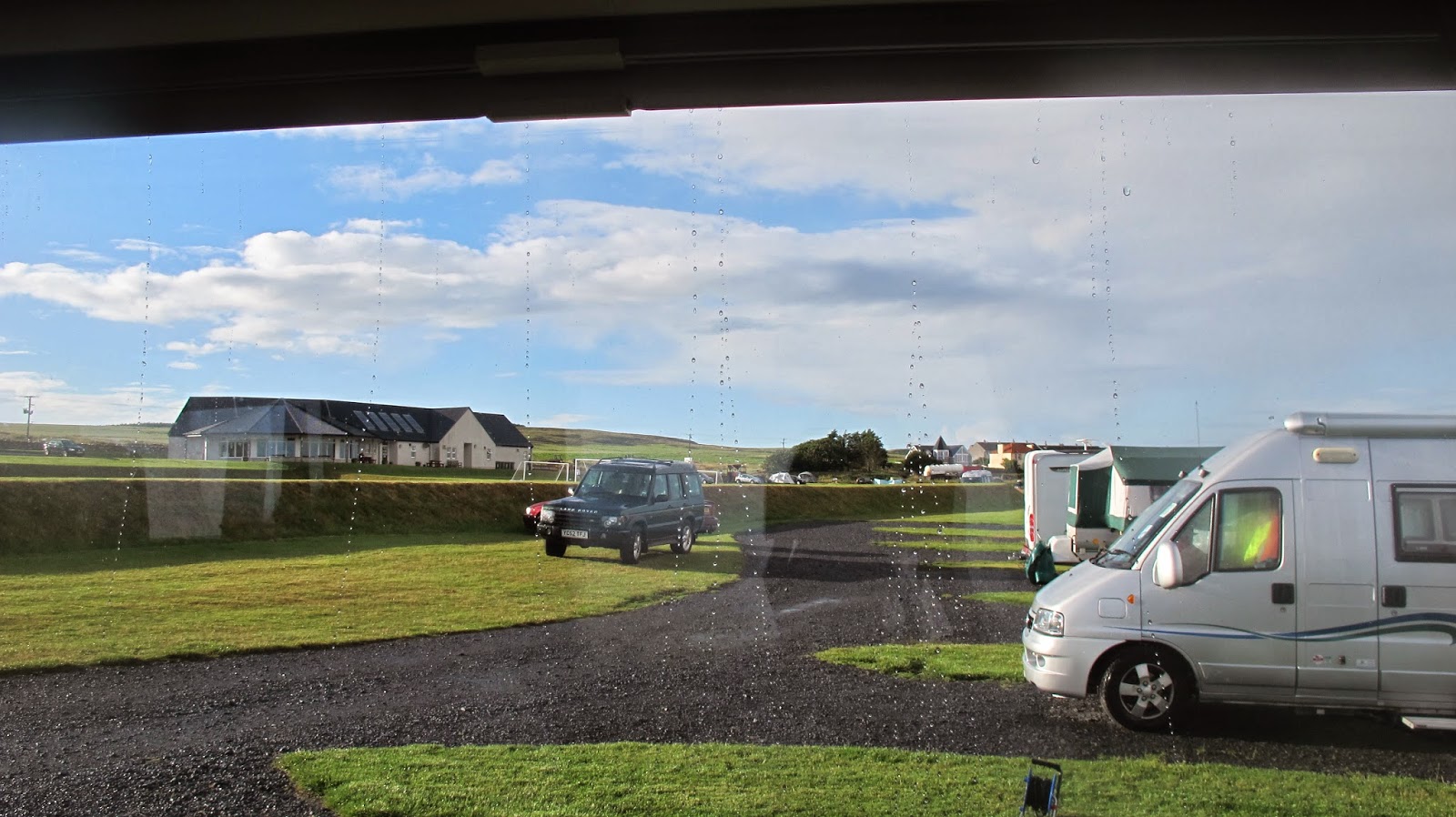
The campsite at Port Mor

Stunning views from the motorhome pitch over Loch Indaal


Monday, 29 July 2013

DAY 6: ON THE ROAD AGAIN- THE JOURNEY TO THE MULL OF KINTYRE AND GATEWAY TO THE INNER HEBRIDES

Friday 26th July

This 7-hour JOURNEY began with an unscheduled detour to take Lord Ruskin to the Academy Vets Practice in Stranraer to check that he was on the mend and had no lasting ill-effects that could cause problems when island hopping later on. After 3 injections and a brief skirmish in the waiting room with a Siamese cat – well… it was presented like a ‘dog’s dinner’ in a posh pink designer cat-carrier and surely intended as bait to test Ruskin’s levels of recovery… I felt comforted that he was nearly back to his old irrepressible self.
Hugging the coastline for much of the route, the first dramatic sight was Ailsa Craig (“Fairy Island” in Gaelic), a giant muffin shaped island that seemed to follow me as an intriguing presence on the horizon for over an hour. Now an RSPB Reserve and home to thousands of seabirds including 40,000 gannets, the island was the safe refuge for persecuted Catholics who escaped there during the Reformation. Its granite is also used for making the finest curling stones.
Also of note was the Isle of Arran, shaped like a kidney bean, and taking centre stage in the Firth of Clyde. The island marks the transition point from the Lowlands to the Highlands of Scotland. Driving from the slower pace of life of rural Ayrshire headlong into the screeching motorway traffic of Glasgow, was a sudden jolt that flung me back into the 21st century. Crossing over the mighty River Clyde Bridge my thoughts drifted from the grey and dilapidated relics of this former industrial powerhouse, to the city’s magnificent 19th century architecture seen on previous visits, such as the elegantly streamlined Art Nouveau designs of Charles Rennie Mackintosh, and the dynamic cultural developments that have rejuvenated Glasgow in more recent times.  Emerging on the other side, the natural world beckoned once again, with the familiar sights of Loch Lomond, and with it the towering and majestic mountains that have stayed with me from other tours. However, this time my JOURNEY was to take me further westwards into new territory, through the Argyll Forest, up the ‘Arrochar Alps’, along the claw-shaped Cowal peninsular and along the low-lying shores of the breathtakingly beautiful Loch Long and Loch Fyne. Making progress in this sort of terrain requires patience and care as the roads are narrow and meandering, but it was an exhilarating drive and rare to see another vehicle. The stunning scenery and constantly changing light as the weather switched from rainstorm to brilliant sunshine were uplifting. I love to see new places, and for me this JOURNEY opened up new horizons of a part of Scotland that was totally unspoilt and devoid of the horrors of the ugly face of tourist development. Having said that, I could not resist stopping off at Inverary for a whisky crunch ice-cream and photo-opportunity with a picturesque sailing ship in the harbour! 


By 6.30pm ‘Bellulu’ was settled in for the night at Corran Farm overlooking West Loch Tarbert, happily coping with no electricity, main sewers, television or mobile phone signals.  I fell asleep with the setting sun and far off cries of the seagulls that called me onto the next stage of my adventure early the next morning, and my ferry crossing to the Inner Hebridean Islands of Islay, Jura and Colonsay.


DAY 5: THE BLACK LOCH OF CASTLE KENNEDY CASTS ITS DARK SPELL ON RUSKIN!

Thursday 25TH July

What a magnificent day this was! A dramatic thunder storm in the night had freshened the atmosphere, but the blue skies and gentle sunshine made a welcome return for my visit to Castle Kennedy Gardens, a 40 minute drive inland. A salad lunch was enjoyed overlooking distant views of the rolling countryside of the outer reaches of the 75 acre estate that was the inspiration of the 2nd Earl of Stair in the 1730’s. I immediately detected the influence of landscape designer ‘Capability Brown’ in the way the natural features such as water, hillsides and grazing flocks of farm animals are visually ‘borrowed’ and integrated into the formality of the planned heart of the gardens through tantalising glimpses afforded at the ends of straight avenues of trees, gateways opened up in walls, and elevated vantage points. The Romantic ruins of Castle Kennedy, built in the 16th century, but burnt down in 1730, provide a wonderful picturesque motif within the formally landscaped grounds. Two natural fresh water lochs, The White Loch and The Black Loch divide the estate, and in the 18th century an army of men with horses and carts were used to mould and move the landscape into its what you see today.  One attraction I had to see was the famous 160 year old avenue of Monkey Puzzle Trees, planted with seed collected by the famous botanical explorer, Joseph Hooker, and I was not disappointed. (The Monkey Puzzle Tree was the subject of a project done with my students). Their towering canopies appeared to claw at the clouds above with their silhouetted spikey fingers, and the mature tree trunks had wise old ‘eyes’ that peered out, where once branches sprouted, and seemed to be watching Ruskin and I on our promenade along the avenue. These Chilean pine trees were under planted with rhododendrons and azaleas that must give a splendid effect when in flower, and I resolve to come back to see these unique and inspiring specimens again. Other memorable features were the giant 2 acre circular pond, filled with rare Victorian water lilies, and the spectacular vistas of trees leading to glimpses of the lochs and focal points, including the elegant Scottish Baronial Gothic styled family seat of Lochinch Castle. Ruskin’s ‘lowlight’ was his swim in The Black Loch, which was cut short by an untimely inhalation of water into his wee lungs which left him trembling and uncharacteristically subdued for the next few hours….
 
My planned excursion that evening to the RSBP reserve of The Mull of Galloway, Scotland’s most southerly point, was aborted en route, as a thick pea-soup Scotch mist dropped down into the narrow lanes I was endeavouring to drive along, and Ruskin’s demeanour became even more dour…..

DAY 4: “GIVING NATURE A HOME”… LOGAN BOTANIC GARDENS

Logan Botanic Gardens (National Trust of Scotland), is a satellite of the Royal Botanic Gardens, Edinburgh, which I know well, as my brother Graham, now a renowned garden designer, photographer and author, was a student of Horticulture there. Logan is a short distance from the Luce Bay peninsular and the beneficiary of the mild gulf-stream micro-climate of this southern tip of the west coast. As ‘the most exotic garden in Scotland’, it showcases tender perennials, trees, shrubs and bulbs from the planet’s southern hemisphere, many of which I recognised from my visits last summer to Australia, Japan and Bali. Having lost several of my own beloved mature cordylines, palms and yuccas to the ravages of our harsh winter of 2012/13, I was amazed that the lush and opulent planting at Logan that reminded me more of the flora and fauna of Australia, Madeira and Tenerife, had survived intact.


Personal highlights were the tropical water lilies in the formal pond, the famous primeval looking Gunnera Bog, sadly without resident dinosaur, and the historic Walled Garden with its living tapestries of spectacular flowering plants collected and brought back by plant hunters from all around the globe for our education and enjoyment. Plants are of course an endless source of inspiration to the artist and below is a photo-collage of images that caught my eye for their stunning variety of colour, form and texture. 


DAY 4: “GIVING NATURE A HOME”… BEACH-COMBER WALK

Wednesday 24th July

This morning I joined a party of holidaymakers staying on the Caravan Club site for a guided educational walk along the beach, accompanied by Paul Tarling, Warden of the nearby RSPB Salt Marsh Reserve at the Crook of Baldoon. We learnt about the culinary, medicinal, agricultural and industrial uses of seaweed, and identified several varieties such as bladderack, sugar kelp and sea lettuce. We heard about sea creatures found beneath our feet that had a symbiotic relationship, some like the naughty innocuous dog whelk that fed on others, the sad plight of the local turtles who died from consuming plastic carrier bags, mistaking them for edible jelly fish, all of which are vital to maintaining a healthy, bio-diverse environment. Much of what Paul told us I knew once but had forgotten, so it was rewarding to focus back down on the amazing stories that some of the individual animals that inhabit our seas and beaches hold, and to appreciate anew their importance to our planet.

  
The new slogan for the RSPB is ‘GIVING NATURE A HOME’, and my next visit of the day continued this theme, in that rather than revealing the threat that mankind presents to the natural world, it celebrated everything that Man can achieve when working in harmony with nature. So, my trip around LOGAN GARDENS followed my hunt for an Internet facility to update my Blog, which I eventually tracked down to a tiny room in the village of Drummore, which was the homespun Tourist Information Centre, staffed by volunteers from the local community, and sadly under threat of closure- another victim of council cuts and the biting recession.

Wednesday, 24 July 2013

DAY 3: A ROYAL BABY AND A FULL MOON COINCIDE


Tuesday 23rd July
Last night I fell asleep to the cries of the curlew and a full moon that heralded the birth of the royal baby flooding the motorhome with a magical light.  I will always associate the royal birth with being in the peaceful setting of Luce Bay, which remained unchanged and oblivious to this much anticipated event. Today I got to enjoy the local beach walks in between the thundery showers, and making friends with some of the very friendly wildlife. More on this in another post!

Meet Percy the Pigeon, Daisy the Dunnock, the Starling Stewart family and Mother and Baby McRabbit…all seen from the motorhome window today…oh, and Robbie the Rat who enjoyed hoovering up the bird seed but was too quick to photograph!