Saturday, 21 July 2012

The Grand Finale of my visit to Japan

Todai-Ji: Home to Nara’s Great  Buddha

My last full day in Japan took me via a train ride to Nara, to see the temple of Todai-Ji, the Nara Museum and the Shinto Kasuga Grand Shrine.  Nara was for a brief period in the 8th century AD, the original capital of the country, and one of the most splendid cities in Asia. The highlight of Todai-Ji is the Great Buddha Hall- the largest wooden structure in the world (yes, really!)  Its purpose was to hold an enormous bronze statue of Buddha, and so make the city the centre  of Buddhism in Japan, and to this day, a magnet for devout followers and tourists alike.  I can see why millions flock here each year – the temple complex and gigantic sculptures have to be seen to be believed. ‘Big’ really is ‘beautiful’ at Nara and the visual impact of the huge scale of the artefacts is surreal and physically and emotionally thrilling. 

 I had to approach the temple through a towering monolithic entrance archway, having promenaded along a straight, wide road for quite some distance,  that had led me through a picturesque deer park with lakes and gardens. The 1,000 resident tame deer are an important feature too, revered  (and pampered with food tit-bits by visitors like me), because they are regarded as messengers of the gods. The moment when I finally saw the Great Hall was one of those rare thrills in your life that you can count on one hand - literally breath-taking!  I was amazed at the enormous scale and magnificence of the richly carved structure, which had been extensively restored over the centuries, following earthquakes, wars, arson, pests and the ravages of the elements and weather (tropical rainstorms punctuated my visit, adding to the drama!) The Great Buddha who looks out from the darkness, is 16 metres (53 feet) high, and weighs 170 tons, and is a miracle of workmanship and artistry. Its colossal form was cast in eight stages, over 3 years, and to give you an impression of the scale, when the figure is given a dusting, 4 or 5 monks stand in the Buddha’s upturned palm! His head, which fell off during an earthquake in 855AD, almost touches the ceiling.  But that was not all …I was also staggered to see other huge sculptures either side and at the back of the Great Buddha hall- 2 golden female figures of Kokuzo Bosatsu, and Niyorin Kannon Bosatsu  seated to either side of the Buddha, and 2  terrifying  guardian deities, protecting the Buddha, that towered over me at 27 feet tall. These were carved out of wood and the degree of skill and realism was outstanding - unbelievable that they had survived from 1203. I lit incense sticks and made offerings of coins alongside other visitors, to pay my own respects to such a holy place, and give thanks for an experience that, over the centuries must have gripped millions of others too – Todai-Ji, a fitting home for some of the most impressive sculptures I have ever been fortunate enough to have seen.

Shinto Kasuga Grand Shrine

Later, embracing the warm tropical rainstorms, I followed the long woodland walk in Nara Park to  search out its Shinto temple, which was also unforgettable.

'Driving rain' by Hiroshige

Set along the route, and amidst the trees were 3000 carved stone lanterns, all donated by ordinary people as spiritual tributes to their ancestors. Many were covered in moss, lichen and undergrowth, almost symbolically being taken back by nature and becoming part of the wood itself. Of seemingly infinite variety each one seemed to have its own sense of life-force and distinct character – no two were alike, and yet many were arranged in matching pairs.

Ascending many steps, I turned a corner, and there from the gloom of the wood, shone out the vividly painted, vermillion temple. The vibrant vermillion colour is synonymous with the Shinto religion and echoed in the robes of the priest, monks and nuns whom I caught glimpses of as they hurried from prayer or some other duty. This building is also a UNESCO World Heritage site, although originally a private family shrine dating back to 710AD. The lantern theme continued around the walkways but these were made from metal and suspended in rows from the roofs in long rows. For certain religious festivals the lanterns in the woods and temple are lit and the effect must be an impressive spectacle.  

Shinto is Japan’s oldest and own religion, existing alongside Buddhism, and its core concept is that deities preside over all things in Nature, be they  living, dead or inanimate. For followers of the Shinto faith this place is one of the foremost Homes of their religion and from my visit I came to a greater understanding of, and connection with their beliefs.

Saturday, 14 July 2012

Memories of a Geisha: My Gion by night walking tour


I was one of a party of 4 who experienced an intimate and fascinating guided tour of the Gion area of the city, which is famous for its Geisha and tea houses, although both can be elusive. One of my favourite films is ‘Memoirs of a Geisha’ and I hoped to see some of the locations where scenes were shot – and I was not to be disappointed! Our local guide knew exactly where the hostels and well-disguised tea houses are located down the narrow alleyways, and pointed them out to us. Imagine my excitement when one of the shuttered doors flew open and out dashed a young apprentice Geisha (Maiko) in the most gorgeous kimono, hair and iconic make-up that I had known for so long from Japanese prints. Before I could grab my camera, she had vanished into the night. But I later saw another chance in the street.


We went to a local theatrical performance of traditional Japanese art forms which was very illuminating and consisted of  Koto - Japanese harp playing, Kado- the ancient Japanese art of flower arranging reflecting the Buddhist relationship with natural forms,  Gagaku- court music, Kyogen- an ancient comic play performed as an interlude for Noh plays, Bunraku- a rather dark puppet play developed over a period of more than 12 centuries, and with a grand finale of Kyomai- a Kyoto style dance that was performed by a local Geisha in beautiful attire to haunting traditional music. This restrained and graceful dance would have been seen at the Imperial Court.


After the show, we walked through the streets taking in the unique surroundings and learnt more about the job of the Geisha from our guide. Although this centuries old profession is in decline, there are surprisingly still around 100 in Kyoto, and a fully trained Geisha can earn £30,000 for one session with a client, where she is expected to entertain him in numerous ways, including the tea ceremony and verbal repartee. The oldest one in Kyoto still working is apparently 91!  Home for the apprentice Maiko and Geiko is a hostel run by a ‘mother’ who takes a large cut of any earnings.


We then guided to a 150 year old traditional Japanese house, that was hidden away in a corner of Gion, to experience an authentic Japanese meal with a family . We were given a warm welcome, leaving our shoes at the door of course, and were served a Zen tempura dinner, consisting of deep fried vegetables and soya products in a crispy batter, served with a tasty horseradish dipping sauce and rice. We ate with chopsticks and drank from the bowls of miso soup with our lips. The way the food was served and eaten was ritualistic and linked to Zen Buddhist practice, as our host explained.


The Tea Ceremony
The highlight of the night was our own personal Tea Ceremony, which was something I will never forget. The daughter of the family guided us through the long, narrow house to a waiting room, where we had to kneel until called by the chimes of bell. We then proceeded through a small but enchanting illuminated garden, across stepping stones and around stunted trees, rocks and trickling water falls, to the Tea House. It was made from wood and bamboo, with paper walls that glowed in the darkness from the lamplight within. To enter, we all had to crawl through a small door at ground level that was about 1 metre square (symbolic we were told, as all classes of Japanese society were welcomed to the tea ceremony but had to get down to the same level; the Samurai could only enter if they left their swords outside as the tea house is a place of peace where everyone is equal). The gracious tea mistress welcomed us dressed in a fine silk kimono, and made us tea using a very specific ritualistic method and special utensils and precious porcelain bowls. She had spent many years learning her art. The sense of calm, simplicity, refinement and restraint was overwhelming, and I felt very privileged to have taken part in this ceremony, that dates back to the 15th century.
We were then taken back to the house for a guided tour around the simply furnished rooms. Family heirlooms going back generations were much admired, and of special note was the family shrine and altar where they prayed to the small statue of Buddha, burnt incense and made offerings of rice and other food items each day.
I went to bed that night with my mind still reeling with the richness of the sights and sounds that I had experienced…and the Homes from Home I had discovered in the backstreets of Gion.


My Pilgrim's Progress: Kiyomizu-dera

Today I went on the Kyoto city bus network and found my way to the Buddhist Temple of Kiyomizu-dera, a spiritual Home for pilgrims of all religious persuasions, for over 1,000 years. 
The local city bus: cheap and efficient
Kiyomizu means ‘pure water’ and I joined the long line of pilgrims in the steep climb to the mountain-top place of prayer, drinking from the sacred spring, and making an offering to the deity, Kannon, the eleven-headed goddess of mercy and benevolence.


Kannon embodies compassion and is one of the most widely
worshipped divinities in Japan.

Drinking from the sacred spring waters


The panoramic views of Kyoto are also famous, and many make the arduous journey to see the cherry blossom in Spring and maple leaves in Autumn – Methinks that one day I will return to feast upon these visions of beauty too – if not in this life, then maybe the next!


Thursday, 12 July 2012

Impressions of three of Kyoto's grandest homes

My first full day in Kyoto, the former ancient capital of Japan from 794AD until 1868, when the Emperor moved his entourage and power base to Tokyo, took in three of its greatest gems, on a guided tour. The homes were fascinating both for their architecture and history.

Nijo Castle  (UNESCO World heritage site)

The fortress-like entrance with moat gives the impression of a
use for defence purposes but it was actually a residence
Visitors have to remove their shoes before entering

Built in 1603 for Tokugawa Ieyasu, who was the first Shogun of the Edo period whose elite Samurai guards protected him and it seems had the right to kill any supected enemies with their fearsome swords. A clever device that the castle is famous for is an early intruder alarm, called the 'nightingale floor', which alerted the guards to approaching assasins. Metal slivers were inserted under the floorboards to let off loud chirping sounds when trodden on, and work as well today as when they were first installed. I guess you can regard this as an early form of our modern day burglar alarm!

This entrance has intricate carvings of birds and plants over the
doorway created with a breath-taking degree of realism and skill

I was sadly not allowed to take photos inside, but this is what the interior of Shogun's grand chamber looked like - the feudal lords are shown paying their respects to the Shogun. The breathtaking wall paintings done on top of gold leaf over paper, were done by Kano Tanyu, and still in wonderful condition considering they were created over 400 years ago. Imagery included life sized pine trees, tigers, cranes, panthers, wild geese, herons, flitting swallows and elegant peacocks.


Kinkakuji Temple (The Golden Pavilion)

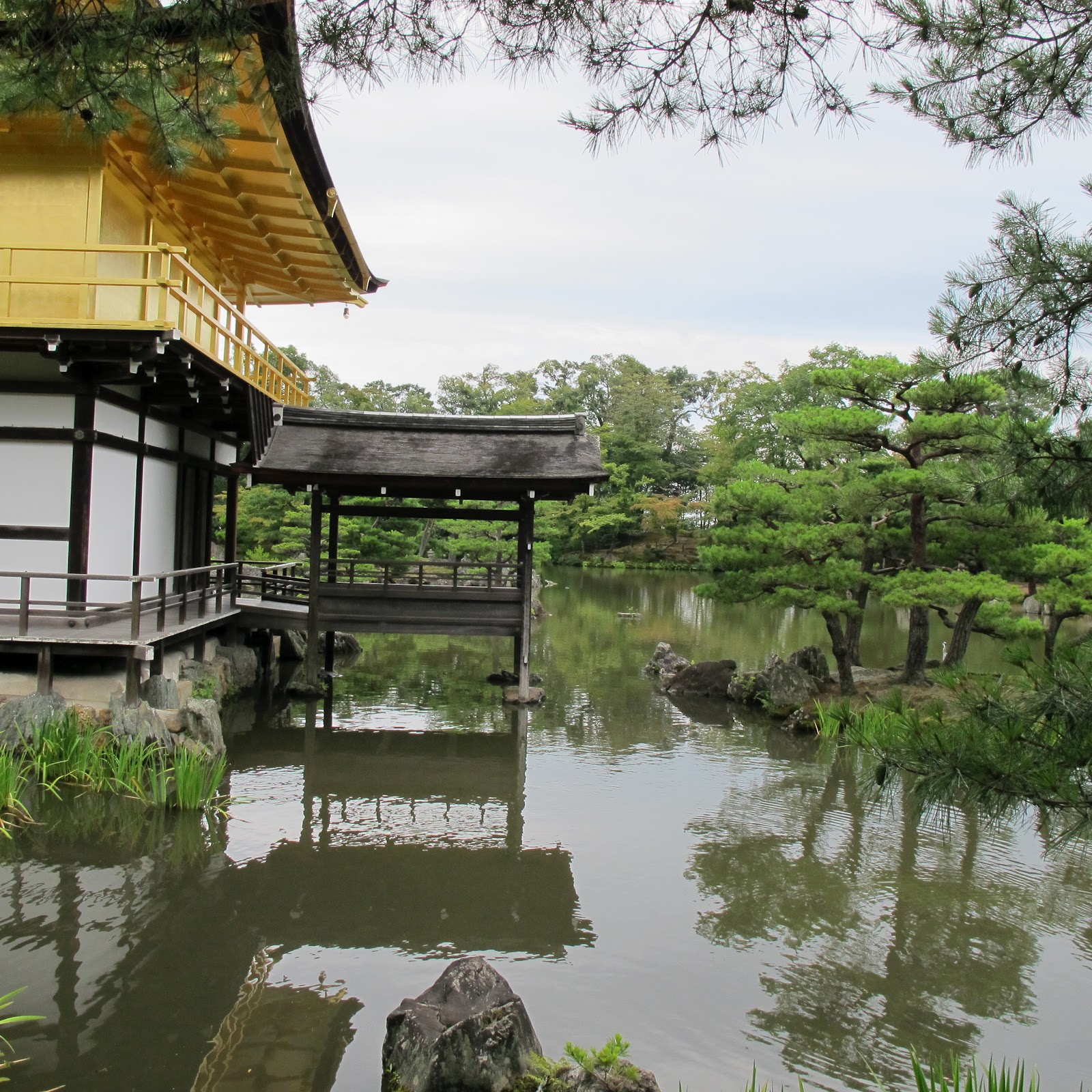
The second place I visited was built as a retirement home for the third Ashikaga Shogun Yoshimitsu, in the 14th century, although the version I saw was an exact reconstruction from the 1950's, because the original was burnt down by a resident rebellious monk, who had the crazy notion that it would look even more beautiful on fire! The arson event is dramatised in the novel by Mishima Yukio 'The Golden Pavilion'. The home was magical, almost like an illusionistic scenery painting, appearing to float above the lake it was set upon. The graceful three storey structure is totally covered in gold leaf (400,000 sheets measuring 10cms square - 6 kilograms of 24 carat - that is some paint job!)

A bronze phoenix sits on the very top of the roof

The stroll around the gardens was inspirational - a masterpiece of the Muromachi period garden design, which aims to achieve a harmonious interplay of its various components such as evergreen plants, water and rocks, that echo the natural landscape, and blend imperceptively into the background of Mount Kinugasa. Somewhere that I could certainly see myself making my own paradise retirement home!


The Imperial Palace and Park (UNESCO World heritage site)

I was very lucky to gain access to this impressive fortress-like former home of the Emperor of Japan, until he moved the capital from Kyoto to Tokyo. It is strictly run by a government agency with visiting strictly controlled. We were closely monitored by slightly sinister guards, and moved along swiftly from each spectacle to the next, with hardly time to take in the detail. Lots of frantic photography! It was officially last used for the coronation of the Emperor in 1915, and the thrones are kept there until needed in Tokyo. There were many impressive buildings in the palace complex, although we were not permitted inside. As with Nijo castle, the structures were built from Japanese Cypress hardwood and dark in colour, and the walls were wooden screens with contrasting translucent Japanese paper infills - these screens were exposed in the day to let light through, but covered at night with sliding doors for protection. The roofs were covered with either ornate ceramic tiles originating from China, or another traditional material that looked like dark brown thatch from a distance but that was actually composed of intricate layers of the bark of the Japanese cypress tree (a highly skilled method that only a few workers in Japan can create today). Here are just a few images to give you an impression. Many more to share with you on my return!


The wall paintings show images of tigers - symbol of the strength
of the Emperor.


The Shishinden ceremonial building where the enthronement of the
Emperor and Empress used to take place. Set amidst a 'garden' of white raked
gravel, the orange and cherry tree either side the entrance symbolise
 longevity and  respect for the emperor.

Traditional roofing method using cypress tree bark layers that
has to be replaced after 40 years but is a fast dying out craft.

The 16 petal chrysanthemum is the symbol of the Emperor of
Japan, seen here on the decorative ends of the ceramic roof tile
Tomorrow I have more adventures planned including hopefully my first glimpse of a real Geisha!

Wednesday, 11 July 2012

My first tastes of Japan


Well, here I am at Japan airport, and making my way to the Japan Rail office to exchange my pre-paid internet voucher for my coverted Japan Rail (JR) card.

Narita airport with my BA plane through the window

The JR office at the station - Note the inevitable Coca Cola adverts!


Precisely 1 minute to get on board - no crossing the yellow line before-hand!

Is it a dolphin, a space-ship or a bullet?
Caught the Shinkansen 'bullet' train, changing at Tokyo to Kyoto, and what an efficient operation it was. Passengers have to queue at a precise spot on the platform, and the train with the carriage your reserved seat is on lines up right in front of you. On time, immaculately clean and the height of efficiency. Hate to say it, but we still have a lot to learn in Britain about the design and operation of our railways. The train was more like a rocket with its aerodynamic shape and clean, bright, hygienic interior, and within 3.5 hours  I was at my destination, having seen a fleeting glimpse of Mount Fuji from the window, which thankfully a British businessman pointed out to me in the nick of time!

Mount Fuji emerging mysteriously from the clouds

Woodblock print of Mount Fuji by Hokusai

 Hotel Granvia was a beautiful, sophisticated home for my four-day stay, chosen because it is in the heart of the ultra-modern Kyoto station (more of that in another post) and therefore less chance of getting disorientated on my arrival. My bathroom had an intriguing piece of Japanese technology - a lavatory that actually had a personal cleansing feature built in, which to the unsupecting user could either thrill or shock, depending on your attitude to personal hygiene...or fun! I think my shrieks and giggles were probably heard 11 floors down in the lobby! Maybe I'll price one of these up on the Internet for my bathroom back home...


The bedroom was tastefully furnished with nice touches of hospitality like Japanese green tea to sip out of dainty, handle-less porcelain teacups, complimentary rice crackers, slippers and an oriental sleeping robe. Some very high tech AV equipment also quickly made this a comfortable home from home, with Internet access allowing me to Skype home to my family- no need for homesickness these days!

I enjoyed a wonderful buffet dinner that night, and tried everything Japanese I could lay my hands on.


Presentation of food in Japan is clearly an artform in itself

Sushi (すし, 寿司, 鮨, 鮓, 寿斗, 寿し, 壽司)

Getting attacked by a crab
 Retiring to bed on that first night, I felt full of excitement about what the new day would bring, with the first of my guided tours around three of the major historic sites planned, bbbbut with a VVVERY early start!

Leaving Home

Farewell Home Sweet Home!

Monday 9th July 2012
Well the big day has finally come and today I headed off for distant lands, departing from Home in Rhosllanerchrugog, at 7.20am and arriving at Manchester airport at 8.30am courtesy of a friend, who dropped me off at Terminal 3 for the internal domestic flight of 150 miles in the capable hands of British Airways. Flight departed promptly at 10ish and I touched down at London Heathrow 1 hour later. Weather grey, overcast ….what has happened to our British Summer?!
Olympics fever was much in evidence at Heathrow airport, which was awash with London 2012 memorabilia, with various shops selling replica GB kits, designed by Stella McCartney and souvenirs also sporting the Union flag in many adapted forms.  It will be strange to miss a big chunk of this epic event, but also interesting to see it from a foreign perspective. 
  

Transfer to Terminal 5 went smoothly, and I found myself sitting on a Jumbo jet waiting to take off for Tokyo, Japan by 1.30pm.  The aeroplane that was to be my temporary Home for the journey was very comfortable,  with pillows, blankets, headphones and entertainment for each passenger. Those in First class even had beds, which as the 12 hour flight unfolded I became increasingly envious of!
  
So, as I leave Britain, the country of my birth far behind, I have the chance to ponder on the very long flight about what does Home mean to me? Roots, security, a refuge from the pressures of life, a place that expresses my own identity, cultural influences and aspirations; a resource to share with family and friends.  My garden is an endless source of pleasure - a microcosm of the natural world that I have lovingly  shaped and moulded to create my own version of Eden – a habitat  for beautiful plants, animals, birds and insects that delight the senses, and as an artist,  inspire through their endless variety of colour, shape and texture, that changes with the seasons and the march of time.
The herbacous border last weekend- frantic last minute weeding!

The final cut before I leave - Ruskin Strong assisting!

My home, Oak Bank, has taken 25 years of hard labour to develop from a near-derelict shell, in the midst of an overgrown jungle,  to what you see today – THOUGHT…. How about using my Home as a resource for you all (dear students) to come and draw and photograph this December?! Here are some photos of my Home at Christmas-time, the most celebrated of festivals that we engage with in western culture, although its religious, Christian meaning seems to have got rather overshadowed with all the tinsel and commercialisation....  myself, I love the tinsel, but it must be in the best possible taste darlings!
The kitchen at Oak Bank


The lounge with my collection of Staffordshire flatbacks
and blue and white china, with complementary Christmas baubles
Anyhow, back to my Home from Home Travels - my next post will tell you about what happened from when I touched down in Japan... my new Home-to-be!